Paper Topic Ideas
Turning an obsession with Fat Bear Week into a research question
by Veronica Vichit-Vadakan on 2025-09-29T14:56:00-07:00 | 0 Comments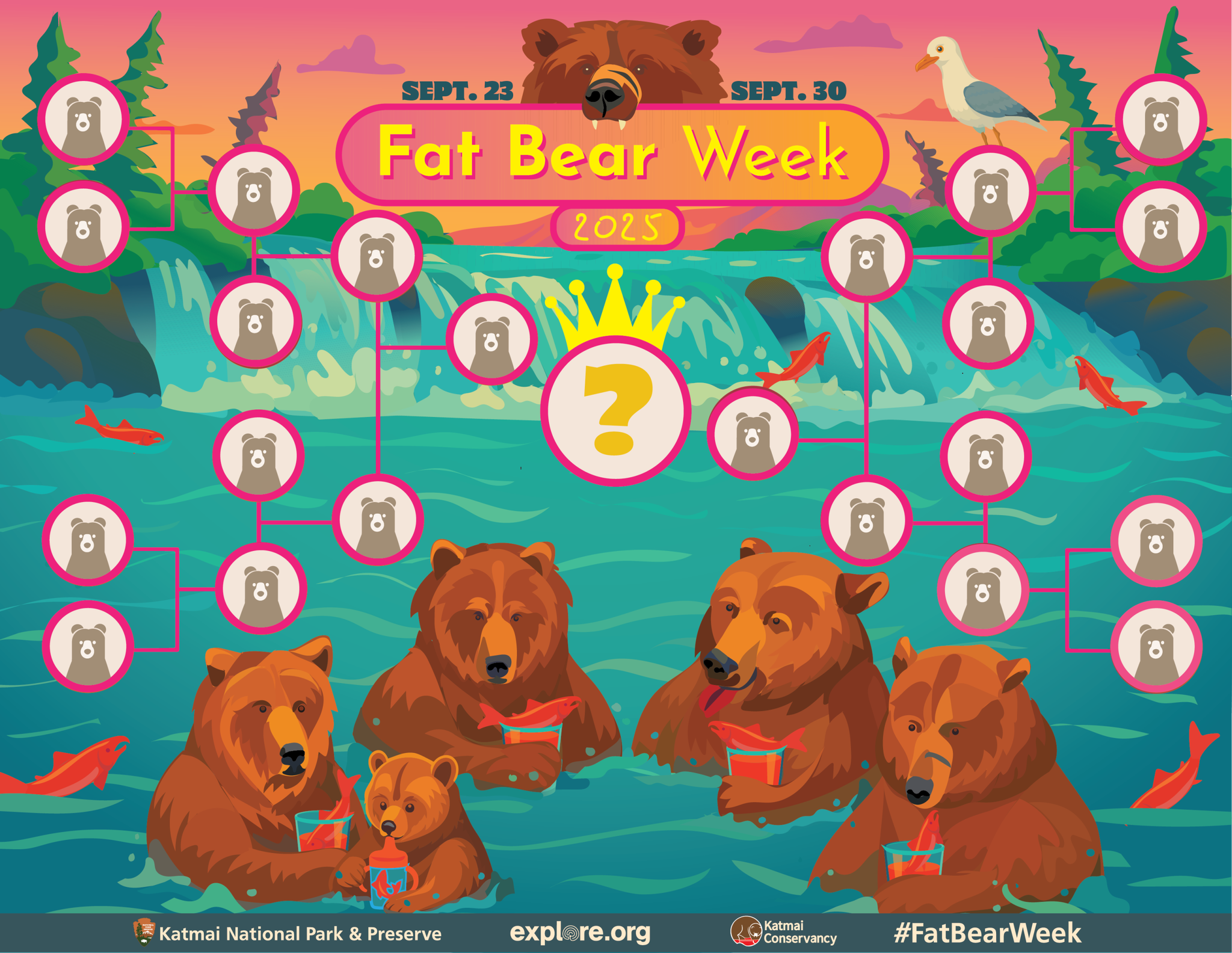
Picture source: fatbearweek.org
Some people get excited about March Madness or the Super Bowl, but the competition that captures my attention every year is Fat Bear Week.
What is Fat Bear Week?
It’s an online voting competition that’s been held annually since 2014. Online viewers get to pick their favorite out of the most chunked up bears in Katmai National Park in Alaska. The park has the world’s largest and most dense population of brown bears, about 2,200 in all. The bears hibernate through the long Alaska winter and emerge in summer to feed for 4 months before hibernating again. Sounds like the life, right?
When they emerge from hibernation in the summer, they are skinny and ragged from sleeping and not eating for 8 months. Talk about extreme bedhead! They have to get to work right away to fatten up for the next hibernation. They fish in the many rivers of the park and scoop as many fresh salmon as they can, gaining as much as 500 pounds in those few months of gorging.

This is bear 856 fishing in Brooks River in Katmai National Park. The two pictures were taken 3 months apart! Picture source: Fatbearweek.org
That feeding frenzy goes on all summer and you can watch the bears on streaming live cams all around the park. It’s fascinating - sometimes a bit gruesome! - to watch the spectacle without having to travel all the way to Alaska.
In late September/early October when bears are at peak weight the Katmai Conservancy runs an event called Fat Bear Week which is part fundraiser, part awareness raising, part bear popularity contest. They create a bracket of some of the largest or most impressive bears and then invite the public to vote on their favorites, crowning a new fat bear king or queen every year.
How do you turn an interest into a research question?
I’m obsessed with the whole event: picking favorites, watching videos, reading the bears’ bios, and now following the lineage of some of the long-time favorites. But how would I turn that into a Research Question?
I want to think about the questions and issues this event raises for me. I’ll try to reach beyond just thinking about how awesome and cute the bears are and think about ways I can explore the topic and learn more.
Here are some initial questions that occur to me.
- What’s the background and history of this event?
- Does Fat Bear Week help or hurt the bears?
- Are the salmon populations in danger of dropping if the bears keep eating all of them?
- Why are there so many bears and salmon in this park?
- Does the excitement around Fat Bear Week help the park? Do they make money from it?
- Does the National Park Service do any other events like this?
- Should we like bears? Aren’t they scary and don’t they kill people?
- Why do some of the bears have names and some have numbers?
- What are bear populations like right now? Are they endangered?
These questions are just starting points to explore the topic and learn more about the event. We’ll develop a research question as I look up answers to each of these questions and learn more about each one.
Start with gathering background information
Check websites and sources you already know
I can look on the Katmai Conservancy website and see what they have to say about what they do and the history of the event. They are a reliable source because they are the organization who puts on the event so it will be interesting to see what they say about it.
Check Library resources
Then I probably want to get the opinion of another organization. Let’s try to get an article from one of our library subscriptions. I am going to put the keywords “Katmai Fat Bear Week” into the library search. Using those words will ensure I am getting formation about Fat Bear Week at this particular park and not just about fat bears in general.
The first search only shows me books and videos, but there’s not much there. So next I will change the dropdown menu at the top to Articles and click the search icon again.
Now I see a lot of articles about Fat Bear Week in Katmai National Park - 73 in all.

I can skim the headlines and pick one that sounds interesting. I click on the title I like and then click on one of the databases links below. The article I chose is called “The Implausible Fame of Fat Bear Week: Why is the world so taken with Katmai National Park and Preserve's pre-hibernation faceoff?” and the link gives me several database options.
I can find more articles from the database by looking at the other options on the list. I can also scroll to the bottom of the page and click on Newspaper Search. Since this is a pretty current event that gets a lot of attention, I can see from the results on the Newspaper Search that there are a lot of articles there, too.

Check other websites
Another option for digging deeper is to look up the Wikipedia page on Fat Bear Week and look at the references listed at the bottom. The links go to places like The New York Times, Huffington Post, and Credo Reference. A lot of these are reliable sources from well-established media outlets, but be careful! These links will often be paywalled, meaning they require a subscription to read. But a lot of them - like the New York Times or Credo - are things that PCC has subscriptions to that you can log into through the Library website. If you run into paywalls while you’re researching, ask a librarian if you can get access.
You can always do a regular Google search, too. Because Google searches tend to give the same information over and over, I like to use some of the specialized tools of Google, like Google News or Google Scholar. Google news is a separate search engine that only searches news sources. And Google Scholar just looks at academic papers. Sometimes, those can be a good way to target your Google searches.
Develop a research question from the information you have
Now I have a lot of background information and can start narrowing in on a research question. The difference between the questions I asked to start out with and a research question is that the first questions have simple answers that I can just look up the answers to. A research question is more complex and will require you to put together information you learn from multiple sources. Here are some examples.
- How do animal conservationists get the general public to care about the importance of animal populations they may never see?
- How does the ecosystem in Katmai Park work and how has it been affected by climate change, pollution, and human intervention?
- How have current federal cuts to the National Park system affected the park, its employees and progams like Fat Bear Week? Is developing a popular program like Fat Bear Week a good idea for other parks to develop revenue streams other than federal funding?
Do you see how these questions require lots of different sources and different kinds of information? For example, that last question about federal funding will require you to find out what the funding sources are for Katmai Conservancy and how that’s changed recently. Because they are a non-profit agency, they must post their annual reports on their website.
Then you might want to look up separately what the whole National Park budget is and how other parks are dealing with cuts. Because they are a federal agency, their budget information is public. Budget details can be found on the National Park website.
Then in addition to these numbers, maybe you can find some information about how budget cuts are affecting parks today. I did a google search looking for the phrase “national park service budget cuts” and found this article about the increased hazards for forest rangers.I did the same search in our catalog, again, remembering to limit the search to Articles and found one titled “"I'm Afraid People Will Die Because of This": Rangers Sound the Alarm Over Mass Firings” - sounds alarming, but relevant.
I also searched Google News for information about National Parks are covering budget and staffing deficits and came across a PBS interview about how the parks are managing with drastic cuts. In short: it’s tough!
Put together with the background information I found about Fat Bear Week, I can create a story about how a fun, lighthearted event has turned into a lifeline for one National Park amidst a budget crisis that’s affecting a lot of parks in many different ways. Plus I got to look at a lot of pictures of chonky bears!

Picture from: National Park Service.
Add a Comment
Search this Blog
Recent Posts
When indecision is the topic decision
Turning an obsession with Fat Bear Week into a research question
Tour de France: So Many Questions!
From Hobby to Research Question
Bad Bunny through the lens of academic research (ft. DtMF)
Subscribe
Enter your e-mail address to receive notifications of new posts by e-mail.
0 Comments.