AI Literacy at PCC
Creative Commons License

Parts of this guide are adapted from:
- AI, ChatGPT, and the Library Libguide by Amy Scheelke for Salt Lake Community College licensed under CC BY-NC-SA 4.0
- Decoding Deception by Diana Daly and Kainan Jarrette licensed under a CC BY NC-SA 4.0
- Generative Artificial Intelligence by The UC San Diego Library, licensed under CC BY 4.0
Changes include rewriting and combining some passages and adding original material.
Always Verify Facts and Citations AI Provides
It’s not a great idea to ever assume that AI is giving you accurate information. AI provided information should always be verified in ways like:
- If AI makes a claim, ask it directly to cite the sources it’s using for that claim.
- When AI provides sources or citations, verify that they actually exist.
- Make sure you can find the sources and citations outside of the AI tool you’re using.
-
Trying copying the citation into a search tool like Google Scholar (make sure it is linked to the Library's database collections!). Do a Google search for the lead author and the publication.
- If a source or citation is real, make sure it says what the AI response says it does. Read the source or its abstract.
- If a source or citation is real, check for bias and reliability as you would for any source. The video below describes the best way to do this using a technique called "lateral reading," a way to investigate sources by doing addition searching for information about those sources.
- Verify claims with additional sources. This could be as simple as searching for a Wikipedia entry on the topic or doing a Google search to see if a person actually exists.
AI Misinformation Example
For an example of how AI and misinformation interact, take this quote for example:
"Remember that there is nothing noble in being superior to some other man. The true nobility is in being superior to your previous self. "
-W.L. Sheldon, from “What to Believe: An Ethical Creed,” Ethical Addresses (Apr 1897)
Maybe you've seen some version of this quote before, but you probably haven't seen it attributed to W.L. Sheldon. That’s because the quote is most often attributed, at least online, to Ernest Hemingway. In fact, if you Google the first line of the quote exactly, the first and most prominent results will tell you it’s a Hemingway quote. It’s in the AI Overview, it’s listed as a Hemingway quote on Goodreads, on Reddit, and so on.
The problem is that Ernest Hemingway never said or wrote this.
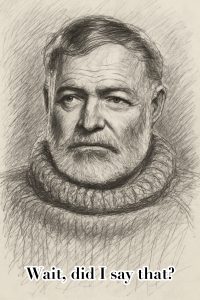 There’s not a single source anyone can point to that verifies this was ever even a quote Hemingway adapted. He simply never said it.
But if you ask AI to identify the quote, it will confidently tell you some form of “this quote is widely attributed to Ernest Hemingway.” And it does this because that’s who the majority of internet sources attribute it to. When you ask it to cite where exactly Hemingway said this, however, it will just as quickly admit that there’s no evidence Hemingway ever said or wrote it.
Here’s where things get even stickier. If you then ask AI to tell you where the quote did originate, it will… make something up. ChatGPT got close by attributing it to the wrong Sheldon, in a text that doesn’t exist. Gemini attributed it to a current middle-aged author, implying the quote didn’t exist before then. And so on
It takes some digging to track down the actual original quote. It first appears in “What to Believe: An Ethical Creed,” by W.L. Sheldon in 1897.
How Misinformation Spreads and Is Reinforced
To begin with, this anecdote is a nice reminder that a lot of quotes floating around the internet are misattributed — keep that in mind the next time you’re about to share one.
While a misattributed quote is generally one of the least harmful types of misinformation, it highlights one of the processes by which misinformation becomes culturally embedded:
- At some point, someone actively decided to misattribute the quote to Hemingway
- Evidence suggests that Playboy magazine was the culprit, as early at the 1960s
- The general public doesn’t question the attribution to Hemingway, likely because:
- Very few people know who W.L. Sheldon was
- Playboy was considered a reputable and influential publication at the time
- It sounds like something Hemingway would have said
- Once the internet became popularized in the 90s, the quote had enjoyed three decades of false attribution without question. What started as misinformation in print media becomes misinformation in digital media.
- The falsely attributed quote is then shared to exponentially larger degrees than before, particularly with the rise of social media and the increasing “memefication” of culture.
- The falsely attributed quote becomes so digitally embedded that even AI (incorrectly viewed by many as infallible repositories of knowledge) declares the quote to be from Hemingway, embedding the misinformation even further into both local and global culture
This gives you an idea of how easy it is for misinformation to spread, even without malicious intent. It also shows how important it is to question the information AI is giving you.
Who Said That?
Try this as a quick exercise:
Think of a quote you love, but that you’ve never verified. Who do you currently think quote is attributed to?
Now, go try to find research where the quote actually originated.
- What do the top Google results say?
- What does AI say?
- Can you find and verify a source of origin? If so, did it match with who you originally attributed the quote to?